
This degree programme Nursing (in German: Pflege B.Sc.) is taught entirely in German.
The other Nursing degree programme, which starts in English, switches to German from the 5th semester onwards
and includes additional German language courses, can be found here: Bachelor’s degree programme Nursing B.Sc.
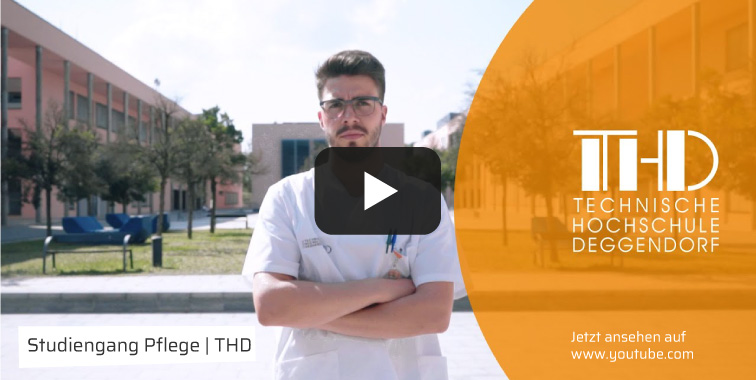
Course Content
Academic nursing qualification
The German healthcare system is currently undergoing radical change. Until now, healthcare has been viewed almost exclusively from a medical perspective, with the expertise of healthcare professionals largely sidelined. As a result, many opportunities for improving care remain untapped. Furthermore, rigid procedures – such as having to consult doctors regarding the next steps in care – combined with a shortage of skilled staff, further limit efficiency in day-to-day work. The result is chronic overwork and frustration amongst nursing staff throughout the entire system. This needs to change.
One of the most important solutions is academic nursing education – in other words, a degree in nursing. In Germany, this is not yet widespread in everyday professional practice, whereas in an international context it has been successfully implemented for a long time. After all, it requires interaction on an equal footing rather than a subordinate role to bring about a sustainable transformation of the system in Germany.
What exactly distinguishes these two paths – traditional vocational training and a degree course – from one another? Their working methods, their responsibilities and their scope of authority in day-to-day work.
To illustrate this, let’s take a brief look at nursing practice: a person is showing signs of confusion. A nurse with traditional vocational training recognises the signs, documents them and informs the relevant medical staff. Later, they implement any medical instructions regarding treatment as required. A nurse with an academic qualification, on the other hand, directly and independently makes the nursing diagnosis of ‘acute confusion’ based on a comprehensive assessment. They take responsibility for developing an individualised care plan – for example, including care interventions to aid reorientation, manage pain and adapt the environment – and, where necessary, recommend that a doctor review the patient’s medication. In addition, they can carry out assessments to identify possible causes of the confusion and intervene with appropriate care measures.
As an academic nurse, your academic training enables you to make nursing diagnoses independently, develop care plans and carry out complex therapeutic interventions. You take responsibility for cases within defined areas of responsibility for specific diagnoses. In contrast, a traditionally trained nurse can and is only permitted to assist with diagnosis, carry out doctors’ instructions and provide basic care and support with daily living.
The benefits of studying nursing:
- A monthly stipend of between 1,100 and 1,400 euros throughout your studies, thanks to the Nursing Degree Strengthening Act
- Focus on academic study and personal development
- Aiming to develop the ability to carry out independent diagnosis and treatment plans
- Academic work
- Career progression opportunities up to a PhD in nursing
You’ll also benefit from close collaboration within the East Bavaria supraregional care network. As part of the training consortium, you’ll not only gain practical experience, but also get to know various organisations in the region, making it particularly easy for you to find a job once you’ve completed your studies.
Work is currently underway in Germany on draft legislation designed to precisely define the scope of practice for academic healthcare professions, thereby further increasing their scope for action and, ultimately, enhancing their appeal.
Your job benefits:
- Interdisciplinary collaboration rather than assistant roles
- Working independently on defined diagnoses
- Responsibility for cases
- Scientifically grounded decision-making and authority to act
- International recognition with a B.Sc. degree
details & Downloads

Subject Overview
Overview of lectures and courses, SWS (Semesterwochenstunden = weekly hours/semester) and ECTS (European Credit Transfer and Accumulation System) in the Bachelor's degree Nursing.
Course Structure
You’ll simply study at DIT, learn the theory behind the subject’s fundamentals and acquire the skills needed for academic work, so that in your professional life you can systematically address key health-related issues affecting society, families and individuals.
You’ll also undertake several placements so that you can learn practical skills. A member of the East Bavarian Nursing Network is responsible for your practical training. As part of this, you’ll be employed by your placement organisation and receive a training allowance of between 1,100 and 1,400 euros per month throughout your degree programme.
Working within the network as a supra-regional training partnership enables you to undertake your practical placements in various areas of care and at different organisations without having to sign a new training contract each time.
Haven't found a practice yet? We're here to help!
We’d be happy to help you find a place within the East Bavaria Care Network so that you can secure a training contract at a suitable facility in Deggendorf or the surrounding districts.
Send an email to praxisreferat-agw@th-deg.de and answer the following questions:
- In what kind of setting would you like to work in the future? Acute care (e.g. hospital), outpatient care (caring for patients at home), residential long-term care (e.g. care home).
- Do you already have a preferred care home?
- Where would you like to live during your clinical placements?
- Do you have your own transport (car)?
- How far are you willing to travel for your clinical placements?
Studying nursing as a registered nurse
Bringing your care experience into your degree – your chance to make a bigger difference
Do you already have professional experience in nursing and want to take the next step? Then a nursing degree is just the thing for you. It is also open to those with professional qualifications and opens up new career prospects – for example, in the specialisation in leadership and management, where you can develop specific skills for managerial roles.
If you have completed a nursing qualification, we will assess on a case-by-case basis which of your credits can be recognised.
Do you have any questions or would you like to find out more about the degree programme?
Contact: Prof. Dr. Christian Rester (Mobil: 0176 2473 2970)
Below you’ll find an overview of everything you need to know as a qualified nurse about studying nursing.
details & Downloads
Subject Overview
Overview of lectures and courses, SWS (Semesterwochenstunden = weekly hours/semester) and ECTS (European Credit Transfer and Accumulation System) in the Bachelor's degree Nursing for registered nursing staff.
Career Prospects
As a nurse with an academic qualification, you work very independently. Your academic background enables you to take responsibility for patient care – including in the areas of diagnosis and treatment.
In large healthcare facilities, you are often part of an interdisciplinary team that is frequently organised across multiple wards. This allows you to make the most of your professional expertise in nursing to promote health efficiently, provide patients with the best possible support and, last but not least, help shape the healthcare system in Germany for the long term. International career opportunities are also open to you.
The nursing degree programme at DIT offers you the best possible foundation for a fulfilling career, where you can exercise personal responsibility and feel valued for your expertise!